The Dark Truth Behind Bikini Bottom: A Scorch Mark in Marshall Islands Nuclear History
Ever think about Bikini Bottom? SpongeBob SquarePants’ whimsical undersea world? You probably picture a super chill place. All laughs, harmless fun. But what if I told you the real Bikini Bottom, Bikini Atoll in the Marshall Islands, isn’t a cartoon dream? Nope. This is where Marshall Islands Nuclear History slammed into reality, leaving a nasty, permanent scar. A place still more radioactive than Chernobyl. Not just some random fact. This is a chilling human tragedy; it echoes even now.
Nope, SpongeBob’s home wasn’t just pulled from thin air. It’s tied to an actual US nuclear testing ground
Behind those bright colors and silly songs, there’s a story nobody really talks about. SpongeBob’s fictional home? Not just a clever name. It’s directly inspired by Bikini Atoll, a chain of islands. In the Pacific. These islands, once a total paradise, became ground zero. For some of history’s biggest nuclear blasts. The contrast between cartoon joy and that real-world horror is just—wild.
The Marshall Islands took a beating: 67 US nuclear tests, 1946-1958. Like the insane Castle Bravo, 1,000 times stronger than Hiroshima
Picture this: From 1946 to 1958, a bomb, roughly 1.6 times the power of the Hiroshima blast, went off every single day on average. Twelve years of that. We’re talking 67 nuclear tests. Not just a few little bangs, either. These were world-shaking explosions. Done on purpose. In the quiet waters of the Marshall Islands.
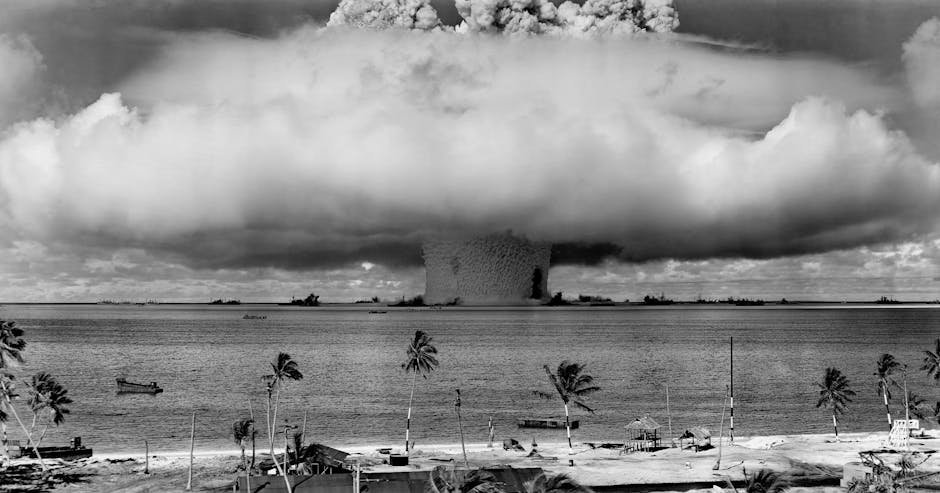
Then came Castle Bravo. The biggest. Definitely the most disastrous. March 1, 1954, 6:45 AM. A hydrogen bomb blew up over Nam Island, Bikini Atoll. They thought it’d be 6-megatons. What they got? A horrifying 15-megaton monster. That’s one thousand times more powerful than the Hiroshima bomb. A blinding flash. Witnesses said it was like the sun rising in the west. The sea turned red. A mushroom cloud exploded, reaching 40 kilometers high. And then? The “death rain.”
Radioactive ash, dust, pulverized coral. It began to fall like snow. Kids on nearby Rongelap Atoll had never seen snow. So they played in it. Tasted it. A seemingly innocent game started a lifetime of suffering.
Indigenous Marshallese people got kicked out, then doused in radiation without knowing. It caused sick bodies, cancers, messed-up births. For generations
The US Navy, having taken over after WWII, “politely” asked the Bikini Islanders to leave their ancestral lands in 1946. “For the good of mankind,” they swore. Just a temporary move. First stop for the islanders? Rongerik Atoll. Not enough food or water, anthropologists said people suffered bad hunger. Then to Kili Island. An island with no lagoon. Traditional fishing was impossible. Vulnerable to harsh waves. Life was rough.
Meanwhile, the bombs kept dropping. The Castle Bravo test, especially, was pure devastation. Despite the weather folks warning winds would shift, communities like Rongelap—only 160 kilometers away—weren’t evacuated. The fallout spread, covering an area the size of New Jersey. Delaying those evacuations? Criminal. Some people never got out. The first signs of radiation sickness were scary: severe burns, hair loss, upset stomachs. But that was just the start.
Over the years, the health problems got chillingly obvious. Acute radiation sickness. Cancers. Lots of thyroid tumors (90% of Rongelap kids got ’em). Also, miscarriages. Stillbirths. Tragic “jellyfish babies” born without bones. Cancer became the second leading cause of death. Yet, there’s still no oncology center there. And another thing: years later, America stopped paying for medical care for these cancer patients. Leaving them with their sickness and no money.
Project 4.1 was a secret US science thing. They made Marshallese people test subjects for radiation. Super messed up
Just six days after Castle Bravo, the US government started Project 4.1. This was no aid effort. It was a secret program. To study radiation’s effects on humans. The official story? Said it was an accidental exposure. But declassified papers years later showed US officials knew the winds would shift. They deliberately delayed evacuation. The “accident” was a chance, a calculated opportunity.
Marshallese people. They had no idea. They became unwitting “lab rats.” Endured painful, unnecessary biopsies. Pregnant women were tested without saying yes. Kids had disturbing medical stuff done. Healthy teeth were pulled. Just to see what radiation did. Women faced humiliating exams from male doctors. Tissues taken. Sent to the US. All without permission. Tony deBrum, a survivor, told the US Congress in 1996. Recounted how “doctor uncles” would line people up, making women strip.
Perhaps the most messed-up twist? In 1956, after calling Rongelap “the most contaminated place on earth,” a big shot from the Atomic Energy Commission suggested sending the displaced islanders back to Rongelap. Her reason? They were “uncivilized” and perfect for studying long-term radiation effects. This “valuable research opportunity” was too good to pass up. In 1957, the Rongelap people went home to their contaminated island. Told it was safe. A deliberate lie. An ongoing human experiment. And this program? Officially ran ’til the late 1970s. A really dark stain on medical ethics.
The environment is still messed up. Radioactive food, water. And “The Tomb,” full of nuclear waste, is cracking as the sea rises
The land itself still quietly suffers. On Runit Island stands “The Tomb.” A 115-meter-wide concrete dome. Built in the late 1970s. It holds 90,000 cubic meters of radioactive soil and nuclear waste. That’s like 35 Olympic swimming pools of deadly stuff. Some waste was even secretly shipped in from US test sites in Nevada.
Today, this thing is cracking. Falling apart. And, because of rising sea levels, it might flood. Releasing its deadly contents into the ocean. Stanford University marine scientists warn the contamination is long-lasting. Almost impossible to fix. Locals tell visitors: do not eat the radioactive coconuts or coconut crabs. Or drink the well water. It’s a place where, as an expert said, “you can’t farm, you can’t eat coconuts, you can’t drink the water.” Even sea turtle shells years later, show traces of uranium. Crazy how permanent the damage is to the ocean life.
Even with all the pain and the challenges, the Marshallese keep fighting for fairness, money, and a simple “sorry” from the US
In 1986, the US offered $150 million for nuclear compensation. It went up to about $600 million with more money later. The US thinks that “solves” the problem. But try telling that to generations still fighting cancer, birth defects, and land they can’t live on. They haven’t even received an official apology. Not even a simple, “We’re sorry.”
The relationship is still complicated. The Marshall Islands relies on Washington for money. So its citizens join the US military more often than Americans themselves. It’s a tangled, heartbreaking situation that just keeps going.
Thiswhole mess is a harsh lesson. About how science can go wrong, the real cost of war, and what happens to local communities
Those turquoise lagoons, those coral reefs of the Marshall Islands? They carry 70-year-old scars. The cracking dome on Runit Island stands as a silent, radioactive monument. Those 67 nuclear tests weren’t just science experiments. They started a tragedy. Twisted lives, generation after generation.
The irony is brutal: tests done “for the good of mankind” and “to end all wars” ended up shattering peaceful communities. The Marshall Islands’ story? A bitter lesson about the true cost of getting ahead scientifically. The real, long-term burden of military ambition. And the deep, often ignored, impact on indigenous people. They’re building a future. In the middle of a dark nuclear past and the huge threat of climate change. Their story definitely doesn’t define them. It’s a testament to incredible toughness. A powerful cry for justice.
Quick Q&A
Q: Where did the Marshallese from Bikini Atoll go after they were kicked out?
A: First, they moved them to Rongerik Atoll—not enough resources there, so people starved. Then to Kili Island, which also sucked for their old way of life because no lagoon.
Q: What was Project 4.1, exactly?
A: Project 4.1 was a super secret U.S. science program. It started right after the Castle Bravo test. They used Marshallese people, who didn’t know what was happening, to study radiation effects. Did unethical medical experiments. Without their OK.
Q: What’s “The Tomb” people talk about?
A: It’s the Runit Dome. It’s a crumbling concrete structure on Runit Island. Built in the late 1970s. It holds 90,000 cubic meters of radioactive soil and nuclear waste. And it’s getting flooded by rising sea levels. A disaster waiting to happen.